
Each autumn, hopefuls around the globe face a choice between two very different paths to permanent residency: the US Diversity Visa Lottery’s stroke-of-luck draw, or the UK’s rulebook-driven visa routes. One hinges on chance—submit your entry and wait for May’s results—while the other asks for a sponsor’s backing, language proof and financial documentation in exchange for a clear timetable. Below is a side-by-side look at how each process unfolds, the paperwork required and the timelines you can count on.
Let’s use a real-time example. Last autumn, Sofia sat at her kitchen table in Sofia, Bulgaria, bouncing between two browser tabs. One was the US State Department’s DV Lottery entry form; the other was the UK Home Office site describing Skilled Worker and Family visas. She had friends in New York who swore by their American dreams, and cousins in London praising the city’s cosmopolitan buzz. Could she—and should she—pursue both paths at once?
If you’ve ever found yourself in Sofia’s shoes, staring down two very different immigration routes, this guide is for you. We’ll walk through:
- How the Green Card Lottery really works—and what it feels like to wait for that May result.
- The ins and outs of UK visas—from job-linked Skilled Worker routes to family-first Partner visas.
- Side-by-side comparisons to help you decide whether to hedge both bets or focus on one.
- Real-world tips (and a few cautionary tales) to keep your applications on track—and your stress levels down.
1. A Compelling Choice: Chance vs Certainty
Imagine two very different journeys:
Journey A begins with a simple online form. You hit “Submit,” then wait for a random draw. You might win big—permanent US residency, free to live and work anywhere in the States. Or you might not hear back at all.
Journey B is a structured process. You identify the UK visa that matches your background—maybe a skilled worker route, a family reunion visa, or a Global Talent endorsement—then follow defined steps with a predictable timeline. If you meet the criteria, your chance of success is high.
Which path appeals to you depends on your appetite for risk, your personal circumstances and how quickly you want certainty. Let’s unpack both options in detail.
2. The Green Card Lottery: A Waiting Game with a Big Payoff
What You’re Signing Up For
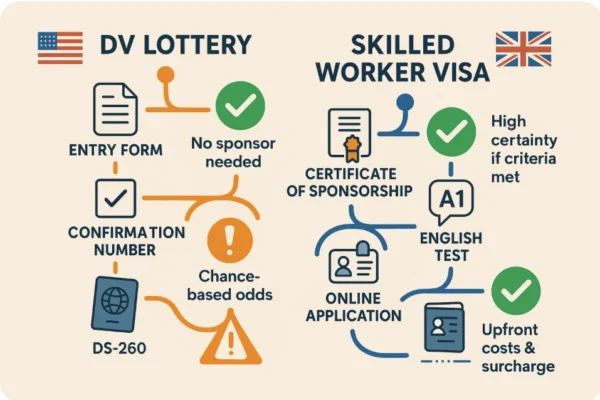
Entering the DV Lottery is almost too easy: fill in your name, birth-country and passport information, click “Submit,” and sit back. There’s no sponsor letter, no bank statements—just hope and a confirmation number you file away like a lottery ticket.
“I felt silly,” recalls Sofia, “like I was scratching a billion-to-one ticket. But it cost me nothing but ten minutes and a cup of coffee.”
Why It’s Tempting
- No job offer needed. You don’t need an employer or family member to back you up—just your high-school diploma (or a couple of years’ work experience).
- Fast track to a green card. Winners bypass temporary visas and go straight to permanent residency.
- Family included. Your spouse and unmarried children under 21 can come along.
The Catch
- Pure chance. Odds vary wildly—sometimes below 1% for certain countries.
- One-time window. You can only enter during that brief October–November period. Miss it, and you wait another year.
- Delayed costs. While entry is free, you’ll pay roughly USD 330 per person in visa fees later, plus medical exams and travel.
Sofia’s Outcome
In May, Sofia logged in to check her status. “I stared at that screen for a full minute before reality sank in,” she says. She’d won. Six months later, she and her husband flew to New York—green cards literally in hand.
But as she settled in Brooklyn, a niggling thought arose: what if the UK had been an option? Which brings us to…
3. Understanding the Green Card Lottery (DV Lottery)
The Diversity Visa Lottery is the signature “chance” route to US permanent residence:
- What it is: A free, annual lottery run by the US Department of State that allocates up to 55,000 green cards to nationals of countries with historically low US immigration rates.
- Why it exists: To diversify the US immigrant population beyond traditional sources.
- Key requirements:
- Birth country must be on the eligible list.
- Education (or work experience): High-school diploma or two years’ work in a qualifying occupation.
- Timely entry: Registration window usually opens each October and closes in early November.
Real-world example: Sofia from Bulgaria applied three years in a row. In her fourth attempt, she won. She completed Form DS-260 online within two months, attended her embassy interview six months later, and landed in New York just under a year after her original entry. Her total out-of-pocket: only the standard immigrant visa fees (~USD 330 per person).
Pros
- No job offer or sponsor needed.
- Can include spouse and children under 21.
- Straight path to a green card—no temporary visas first.
Cons
- Chance-based: Odds vary by country (often below 1–2%).
- Timing: You must wait for the next registration window; results arrive in May.
- Fees later: While entry is free, winners pay immigrant visa and medical exam fees.
4. Exploring UK Visa Routes
The UK’s immigration system offers multiple “criteria-driven” routes, each tailored to different profiles. Here are the most popular:
| Route | Ideal for | Key Requirement |
| Skilled Worker Visa | Professionals with UK job offers | Job offer from a Home Office–licensed sponsor |
| Global Talent Visa | Exceptional talent in science, arts, tech, humanities | Endorsement by a designated UK body |
| Spouse/Partner Visa | Family reunification | Genuine relationship + financial threshold |
| Student Visa | Academic study | Confirmation of Acceptance (CAS) from a UK institution |
| Start-Up & Innovator Visas | Early-stage entrepreneurs | Business plan + investment fund |
Each route leads—after 5 to 10 years on visa—to Indefinite Leave to Remain (ILR), the UK’s equivalent of permanent residence.
Case in point: Rajesh secured a Skilled Worker Visa through his London tech employer. He arrived six weeks after his application, began work immediately, and logged five years in the UK before qualifying for ILR. His process was predictable but came with sponsor fees, visa costs (£900–£1,400) and an annual Immigration Health Surcharge (~£1,035 per person).
Why the structure matters
- Clarity: You know the requirements up front—no luck of the draw.
- Speed: Most visas processed within 4–12 weeks.
- Dependants: Spouses and children can apply with you, but you’ll need to demonstrate extra funds.
5. Side-by-Side Comparison
| Feature | Green Card Lottery | UK Visa Routes |
| Selection process | Random draw | Criteria-based eligibility |
| Initial cost | Free entry; visa fees if selected | Upfront application & health surcharge |
| Processing time | Draw result → 6–12 months to visa | 3–12 weeks per application |
| Success certainty | Unpredictable | High if you meet criteria |
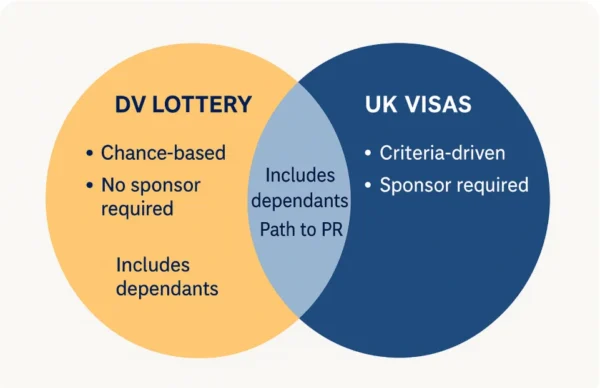
| Inclusion of dependants | Yes—spouse & under-21 children | Yes—proof of finances required |
| Settlement path | Direct green card | Visa → ILR after qualifying residence |
6. Who Should Apply—and When?
Risk-takers without sponsors
You have no UK job or family ties but qualify for the DV Lottery. You can tolerate uncertainty and a once-a-year window.
Professionals with clear UK prospects
You’ve secured a UK employer or have exceptional talent. You prefer a structured process and faster decision.
Dual applicants
You meet basic DV Lottery requirements and have a UK pathway.
Tip: Submit your DV Lottery entry in autumn and start your UK visa application in parallel. This hedges your bets—if you win the lottery, you can re-route; if not, you still have your UK plan.
Family reunifiers
You’re joining a spouse in the UK or have close family there. UK Partner visas demand stringent proof of relationship and finances but offer predictability.
7. Real-Life Scenarios
Scenario A: Elena’s Parallel Play
Elena, an IT specialist from Spain, did both. She applied for the DV Lottery three years straight—and secured a UK Skilled Worker Visa on her first try. She takes the UK visa as her Plan A and views the US lottery as a bonus.
Tip from Elena: “I set up calendar alerts—for the DV entry window in October, my IELTS test date in June, and my visa application timeline. That way, nothing slips through.”
Scenario B: Amit’s Family-First Focus
Amit wanted to join his wife in Manchester. He didn’t bother with the lottery; the UK Partner Visa gave him 33 months of permission to live, work and study—sufficient certainty for their young family.
Tip from Amit: “Gather relationship proof like a scrapbook—tickets, photos, even screen-shots of video calls. It all paints a picture of genuine partnership.”
8. Practical Application Walkthroughs
A. Steps for the DV Lottery
- Enter your details on the official DV website (October–November).
- Download your confirmation number—vital for result checking.
- Check results each May on the State Department portal.
- If selected, file Form DS-260 and upload civil documents (birth, marriage, police certificates).
- Attend your embassy interview, pay immigrant visa fees (~USD 330), and receive your green card upon entry to the US.
B. Example: Skilled Worker Visa Route
- Secure a Certificate of Sponsorship from your UK employer.
- Prove English proficiency (e.g., IELTS at CEFR level B1 or above).
- Show maintenance funds: £1,270 per applicant (unless your sponsor certifies support).
- Apply online with supporting documents and pay fees (£625–£1,423 + IHS).
- Complete biometrics at a visa application centre.
- Receive decision within 4–8 weeks and collect your visa vignette.
9. Costs & Timelines at a Glance
| Route | Fee per Applicant | Health Surcharge | Decision Timeframe |
| DV Lottery (if selected) | USD 330 | N/A | 6–12 months |
| Skilled Worker Visa | £769 | £1,035 per year | 4–8 weeks |
| Spouse/Partner Visa | £1,938 | £1,035 per year | 12–24 weeks |
| Global Talent Visa | £766 | £1,035 per year | 3 weeks |
Tip: Always check the latest Home Office and State Department fee schedules before applying—they update annually.
10. Top Tips for Maximizing Your Chances
- Apply early: DV Lottery opens in October; don’t wait for the last day.
- Keep meticulous records: Save screenshots, confirmation numbers and appointment letters.
- Stay informed: Both US and UK immigration rules evolve—subscribe to official newsletters.
- Seek specialist advice: Complex cases (e.g., criminal history, unusual employment) benefit from expert guidance.
11. FAQs
Q1: Can living in one country exclude me from the other lottery/visa?
- DV Lottery: No—only your country of birth matters.
- UK visas: You can apply from inside or outside the UK, depending on the route.
Q2: If I win the DV Lottery, can I still use my UK visa later?
Yes. Winning the lottery does not prevent you from applying for or maintaining UK status; however, dual-residence may affect your tax and immigration records in both countries.
Q3: Which route is “best”?
- For low-risk: UK visas offer clarity if you meet criteria.
- For high-reward chance: DV Lottery is free to enter but unpredictable.
12. Next Steps & Expert Support
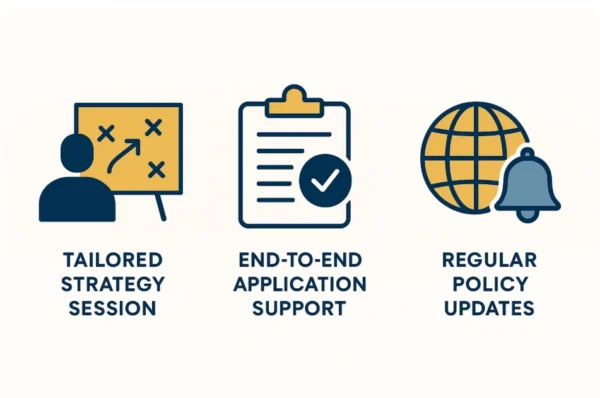
Navigating two major immigration systems simultaneously can be daunting. At Barar & Associates, we combine our UK immigration expertise with a network of trusted US partners to deliver:
- Tailored strategy sessions: Assess your profile for both DV Lottery and UK visa options.
- End-to-end application support: From document checks to embassy interviews.
- Regular updates: We monitor policy changes that could affect your applications.
Ready to plan your future—Stateside, Britain or both? Book your strategy session today, and let’s turn that kitchen-table daydream into reality.
Disclaimer: UK immigration rules, regulations and government fees are subject to change at short notice. Applicants should consult the latest Home Office guidance and official fee schedules—or seek qualified legal advice—before submitting an application.