If you’re looking to live and work in the United Kingdom, the Skilled Worker Visa is the primary immigration route for international professionals. It allows UK employers to hire skilled talent from abroad for eligible roles and provides a clear path to permanent residency and citizenship. This guide explains every step of the process — from sponsorship and costs to documents, compliance, and long-term settlement.
What Is the Skilled Worker Visa?
The Skilled Worker Visa UK is a points-based immigration route that replaced the Tier 2 (General) visa in 2020. It allows foreign nationals to live and work in the UK if they have a confirmed job offer from a licensed sponsor in an eligible role that meets salary and skill thresholds.
Key Features:
- Valid for up to 5 years, with extensions allowed
- Leads to Indefinite Leave to Remain (ILR) after 5 continuous years
- Includes dependents (spouse and children)
- Requires a Certificate of Sponsorship (CoS UK) issued by the employer
Skilled Worker Visa Fees in 2025
Understanding the cost of a Skilled Worker Visa is crucial for planning your move to the UK. Here’s a full breakdown of the most current visa fees and related costs for applicants:
Skilled Worker Visa Application Fees (as of 2025):
| Visa Duration | Application from Outside UK | Application from Inside UK |
| Up to 3 years | £1,321 | £1,938 |
| Over 3 years | £1,519 | £1,751 |
| Job on Shortage Occupation List (regardless of where applying from) | £590 (up to 3 years) | £1,160 (over 3 years) |
Immigration Health Surcharge (IHS):
Applicants must also pay an annual IHS fee of £1,035/year, covering access to the NHS.
Example: A 3-year visa = £719 (visa) + £3,105 (IHS) = £3,824 total, excluding dependents.
Dependent Visa Fees and IHS
If you’re bringing family members, each dependent needs their own visa and must pay associated fees. These often mirror the main applicant’s costs.
Dependent Visa Fees:
| Dependent Type | Application Fee | IHS Fee (3 years) | Total |
| Spouse / Partner | £719 | £3,105 | £3,824 |
| Child (under 18) | £524 | £776 (per year) | £2,852 |
Additional Costs:
- Biometrics & visa centre fees (varies by country)
- Tuberculosis test (if applicable)
- Accommodation evidence if applying from abroad
Who Can Apply?
To be eligible for a Skilled Worker Visa, the applicant must:
- Have a job offer from a UK-licensed sponsor
- Be assigned a Certificate of Sponsorship
- Be offered a role from the Skilled Occupations List
- Meet the minimum salary requirement (typically £26,200/year or £10.75/hour)
- Demonstrate English language proficiency
- Provide proof of personal savings, unless exempt
- Meet health and character requirements
Applicants already residing in the UK on a valid visa (such as a Graduate or Student visa) can switch to the Skilled Worker route.
Eligible Occupations and Industry Sectors
The UK Skilled Worker Visa is available to applicants working in approved job roles. These roles are listed under Standard Occupational Classification (SOC) codes on the official Skilled Worker Occupation List, which is updated regularly.
High-Demand Industries:
- Healthcare (nurses, care workers, paramedics)
- IT & Tech (software engineers, IT business analysts, cybersecurity specialists)
- Engineering (civil, mechanical, electrical)
- Construction (bricklayers, electricians, welders)
- Education (secondary school teachers for maths, physics, computer science)
| Occupation Example | SOC Code | Typical Salary Threshold |
| Software Developer | 2136 | £34,000+ |
| Registered Nurse | 2231 | £26,200+ |
| Secondary School Teacher (Maths) | 2314 | £29,000+ |
You can check the full and most recent Skilled Worker Visa occupation list here.
Step-by-Step Application Process
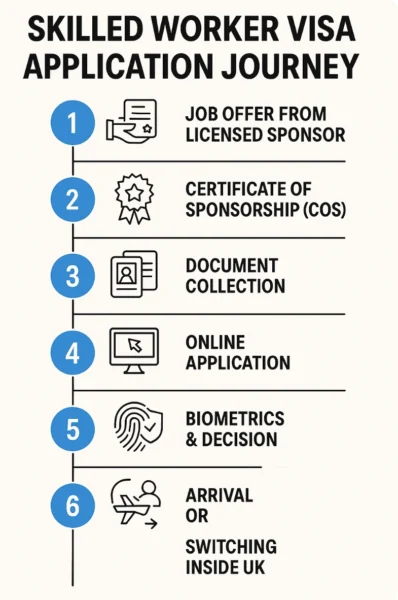
1. Secure a Job Offer
Applicants must obtain a formal offer from a UK employer with a valid Sponsor Licence. The job must align with one of the eligible roles listed on the official Skilled Occupations List.
2. Obtain a Certificate of Sponsorship (CoS)
The employer will assign a CoS, which includes:
- Job title, occupation code, salary
- Start and end dates
- CoS reference number
The CoS is valid for three months from the date of issue.
3. Prepare Documents
The following are typically required:
- Passport
- CoS reference number
- English language certificate (e.g. IELTS for UKVI, degree taught in English)
- Bank statements (if proof of funds is needed)
- Criminal record certificate (for certain roles)
- Tuberculosis test results (if applicable)
4. Apply Online
Applications are submitted via the UK Visas and Immigration portal. The applicant must pay the visa fee and the Immigration Health Surcharge (IHS).
5. Attend a Biometric Appointment
Applicants may need to attend an appointment at a visa application centre to submit fingerprints and photos.
6. Wait for Decision
- Outside UK: usually 3 weeks
- Inside UK (switching): up to 8 weeks
Priority and super-priority services are available at an additional cost.
Costs Breakdown
| Item | Amount |
| Visa fee (up to 3 years, outside UK) | £1,519 |
| Visa fee (inside UK) | £885 |
| Shortage occupation roles (inside or outside the UK) | £590 up to 3 years/£1,160 over 3 years |
| Immigration Health Surcharge | £1,035/year |
| Certificate of Sponsorship | £525 |
| Priority Processing (optional) | ~£500 |
Total Typical Cost (3 years): £2,800–£3,500
Some employers cover part or all of these costs.
Sponsorship Requirements for Employers
To hire a Skilled Worker, an employer must:
- Hold a valid Sponsor Licence
- Assign a compliant Certificate of Sponsorship
- Meet salary, skill level, and occupation code requirements
- Report employee activity (e.g. absences, role changes) to the Home Office
- Pay the Immigration Skills Charge:
- £1,000/year per worker (large businesses)
- £364/year (small companies and charities)
Sponsorship & Certificate of Sponsorship (CoS) Costs
Employers must bear specific financial responsibilities when sponsoring a worker.
Employer Costs:
| Cost Category | Amount |
| Sponsor Licence Application | £574 (small) / £1,579 (large) |
| Certificate of Sponsorship (CoS) | £525 |
| Immigration Skills Charge | £364/year (small orgs) or £1,000/year (larger businesses) |
NHS Employers: While the CoS cost remains at £525, some healthcare employers may receive partial fee exemptions under the Health & Care Visa.
Note for Employers:
Costs are per employee. Failing to meet compliance obligations can result in suspension or revocation of your sponsor licence.
Pathway to ILR (Indefinite Leave to Remain)
The Skilled Worker route is one of the clearest paths to settlement in the UK.
ILR Eligibility Timeline and Conditions
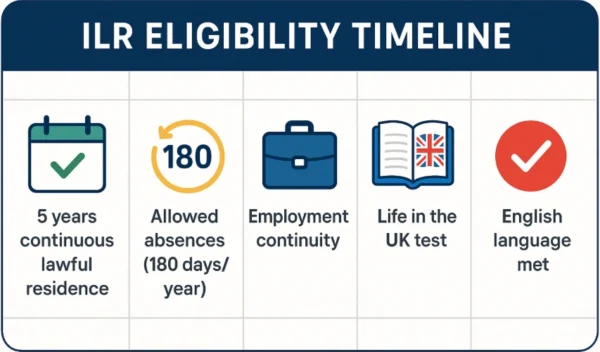
To qualify for Indefinite Leave to Remain (ILR) under the Skilled Worker route, applicants must meet the following:
| Requirement | Detail |
| Time in UK | 5 continuous years under a Skilled Worker visa or eligible combination (e.g. Tier 2) |
| Absence Limit | No more than 180 days outside the UK in any 12-month period |
| Continuous Employment | Must be with a UK sponsor or in an eligible job role throughout |
| Valid CoS | Your latest Certificate of Sponsorship must still be valid and aligned with your employment |
| Salary Threshold | Must meet the current ILR salary threshold (e.g., £38,700 or higher depending on job) |
| Life in the UK Test | Mandatory for ILR – tests knowledge of UK history, law, and culture |
| English Language Requirement | Proof of CEFR level B1 or higher unless already proven in previous visa application |
Special Considerations:
- Maternity/Paternity Leave: Does not count as a break in employment if declared and recorded.
- Unpaid Leave or Sabbatical: May affect continuity unless employer-sponsored and declared.
- Job Changes: If you switch employers, your 5-year clock does not reset, but you must notify UKVI and obtain a new CoS.
Skilled Worker Visa Occupation List Overview
This visa covers a wide range of job roles across high-demand industries. Examples include:
- Healthcare: nurses, care workers, paramedics
- Technology: software developers, cybersecurity specialists
- Engineering: civil, mechanical, electrical engineers
- Education: secondary school teachers in maths, physics, computer science
A full, regularly updated list can be found on the GOV.UK Skilled Occupation List.
Real-World Case Study: Ana from Brazil
Ana, a civil engineer from Brazil, received a job offer from a UK infrastructure firm in 2020. She applied for a Skilled Worker visa, moved to London, and has since advanced in her career. By 2025, she fulfilled ILR requirements and applied for settlement. Her employer supported her sponsorship throughout, and her dependents joined her in the UK with full work and study rights.
Real-World Journey: From Overseas to UK Settlement
Case Study: Isha, IT Project Manager from India
- Year 1: Isha secures a job offer from a London-based fintech company. Her employer holds a Sponsor Licence and provides her with a CoS. She applies from India and gets approval in 3 weeks.
- Year 2: Isha moves to the UK with her husband and 5-year-old daughter. She begins working and her partner gets a dependent visa with full work rights.
- Year 3: Her company is acquired, and she switches to a new sponsor within the same role. She updates her visa accordingly.
- Year 5: Isha applies for ILR, having passed the Life in the UK Test and maintained salary and residency continuity. One year later, she obtains British citizenship.
This journey reflects the flexibility and long-term stability offered by the Skilled Worker route — when managed correctly.
Choosing the Right Employer: What to Look For
Not all UK companies are eligible to sponsor skilled workers. Here’s how to assess whether your prospective employer is legitimate and suitable:
Tips:
- Confirm they are listed on the UK Sponsor Register (GOV.UK has a searchable database).
- Request your CoS reference number in writing before proceeding with a visa application.
- Ask about their previous experience hiring international workers.
Red Flags to Avoid:
- Requests for upfront payment for sponsorship
- No physical office or unclear contact details
- Refusal to provide written employment contracts
Use the Register of Licensed Sponsors to verify your employer’s eligibility.
Switching to a Skilled Worker Visa

You can switch to this visa from inside the UK if you’re currently on:
- Graduate visa
- Student visa
- Tier 2 ICT
- Family visa
You cannot switch from a:
- Visitor visa
- Short-Term Study visa
Required Documents for Skilled Worker Visa
You’ll need to prepare and upload the following documents:
| Document | Mandatory? | Notes |
| Valid Passport | ✅ | At least 6 months validity |
| Certificate of Sponsorship (CoS) | ✅ | Reference number from your employer |
| Proof of English Proficiency | ✅ | IELTS for UKVI, UK degree, or equivalent |
| Proof of Personal Savings | ✅/❌ | £1,270 unless employer is A-rated and covers this |
| Tuberculosis Test | ✅ (if applicable) | Required for certain countries |
| Police Certificate | ✅ (some roles) | Especially for healthcare/education |
| Life in the UK Test (for ILR only) | ❌ | Required at ILR stage, not for initial application |
| Optional: CV or Work History | ❌ | Recommended to include |
| Optional: Previous UK Visa Copies | ❌ | Helps streamline switching applications |
Employer Guidance: Applying for a Sponsor Licence

UK employers who want to hire foreign workers must:
- Apply online via the Home Office portal
- Provide supporting documents (e.g., VAT certificate, company bank statements)
- Pay the application fee:
- £536 (small business)
- £574 and £1,579 (small/large business)
- Nominate:
- Authorising Officer
- Key Contact
- Level 1 User (for managing sponsorships)
- Prepare for a UKVI audit or compliance visit
The licence typically lasts 4 years and must be renewed.
Common Sponsor Compliance Mistakes
| Issue | Consequence |
| Failing to report employee absences | Loss of licence |
| Assigning CoS to ineligible roles | Visa refusals, compliance warnings |
| Not maintaining HR records | Breach of sponsor duties |
| Late reporting of job changes | Legal liability and penalties |
Employers must use the Sponsor Management System (SMS) to keep records updated and respond to Home Office requests.
Tier 2 Visa vs Skilled Worker Visa
The Skilled Worker Visa replaced the Tier 2 (General) visa in 2020. However, many still refer to it by its former name. Here’s how the new visa compares:
| Feature | Tier 2 (Old) | Skilled Worker Visa (New) |
| Introduced | Pre-2020 | Dec 2020 |
| Salary Threshold | £30,000 (general) | £38,700 or higher, depending on a job |
| English Requirement | IELTS or UK degree | IELTS UKVI, SELT, etc. |
| ILR Route | Yes | Yes |
| Dependents Allowed | Yes | Yes |
| Shortage List Discounts | Limited | Expanded |
The Skilled Worker Visa is more flexible, allowing more roles and industries to qualify — especially healthcare and IT.
FAQs
Can I work part-time on a Skilled Worker Visa?
Yes, if your main job meets the minimum salary and hours threshold. Part-time work is allowed as long as it doesn’t affect visa conditions.
Can I study in the UK on this visa?
Yes. You can take part-time or evening courses, but your main purpose must remain employment.
What if I change employers?
You must apply for a new Skilled Worker visa with a new CoS. Your 5-year ILR clock continues but must remain continuous.
Can I travel abroad freely?
Yes, but don’t exceed 180 days outside the UK in any 12-month period — otherwise ILR eligibility may be affected.
What happens after I get ILR?
You can apply for British citizenship after 12 months, provided you meet residency, language, and good character requirements.
How Much Does a Skilled Worker Visa Really Cost in Total?
Here’s a real-world breakdown of the total cost for a 3-year Skilled Worker Visa with one dependent:
| Category | Main Applicant | Dependent | Total |
| Visa Fee | £769 | — | £769 (for both) |
| IHS Fee (3 years) | £3,105 | £3,105 | £6,210 |
| CoS (paid by employer) | £525 | — | £239 |
| Total | — | — | £7,887 |
Tip: Some employers may offer relocation packages that partially cover these costs — always check when negotiating your job offer.
Final Thoughts
The Skilled Worker Visa remains a cornerstone of the UK’s immigration system — offering opportunities to professionals while supporting sectors facing talent shortages. With the right preparation and support, it can open the door to permanent residence and citizenship.
Need Help?
At Barar & Associates, our immigration lawyers assist both individuals and employers with every step of the Skilled Worker Visa process — from sponsorship and document preparation to compliance and settlement planning.