

The UK government’s May 2025 White Paper, Restoring Control over the Immigration System, together with the rapid roll‑out of the UKVI e‑Visa platform, marks the most sweeping post‑Brexit reform of immigration rules to date. Touted as a way to “reduce net migration and promote growth,” these measures have sparked serious concern that, rushed into law, they risk destabilising critical sectors, overburdening businesses, and imposing real hardship on migrants and their families. Below, we unpack every key change, analyse its likely ripple effects, and highlight essential next steps for employers and migrant workers alike.
1. The Big Picture: Aspirations vs. Realities
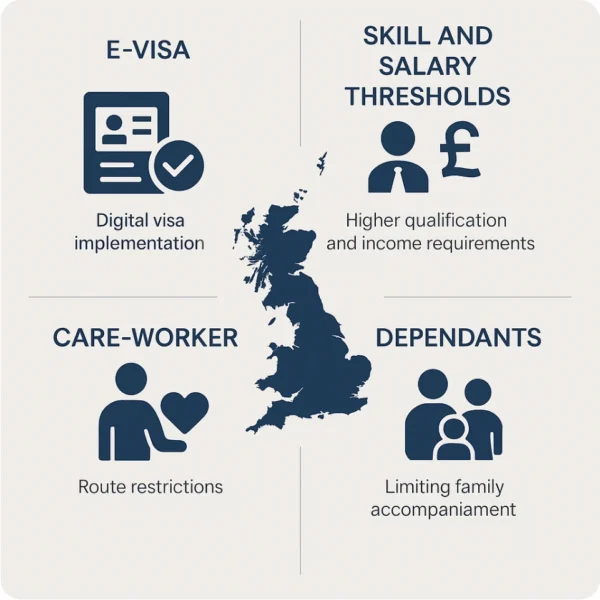
The White Paper rests on five principles—control, fairness, growth, integrity, and efficient borders—but its main levers are:
- Tighter Skills & Salary Thresholds
- Closure of Care‑Worker Routes
- Stricter Dependant Rules
- Mandatory E‑Visa Migration
In parallel, the e‑Visa system will replace physical vignettes and BRPs, requiring over 300,000 existing visa‑holders to register by mid‑2025.
Transitional Protection
Current Skilled Workers in RQF 3–5 roles can renew, switch, and extend under existing rules—subject to review—until their next application cycle. However, this window closes on 22 July 2025.
2. E‑Visa Roll‑Out: Digital Burden or Digital Opportunity?
| Date | Change |
| 2 June 2025 | End of travel concession on expired BRPs/BRCs—travel on expired vignettes now invalid. |
| 15 July 2025 | No more 90‑day vignettes for Students, Skilled Workers, Sportspersons—automatic e‑Visa only. |
| Mid‑2025 onward | ILR holders must convert ink stamps to e‑Visas via “No Time Limit” applications. |
- Action Required: Over 300,000 migrants must create UKVI accounts and complete e‑Visa registration by summer 2025 to avoid travel disruptions.
- Opportunity: Digitisation promises quicker renewals and easier international mobility—if you meet the deadlines.
3. Skilled Worker Route: Raising the Bar
From RQF 3 to RQF 6
- Old: Eligible roles at RQF 3 (A‑level) and above.
- New: Only RQF 6 (degree level) and above—eliminating roughly 180 occupations from core eligibility.
- Temporary Shortage List (TSL/ISL): Some RQF 3–5 roles survive, but incoming applicants may no longer bring dependants.
Salary Threshold Overhaul
| Category | Old Threshold | New Threshold |
| Standard Skilled Worker | £38,700 | £41,700 |
| Senior/Specialist Worker | £48,500 | £52,500 |
| New Entrant | £30,960 | £33,400 |
- No Grandfathering: All applications—new and extensions—must meet these higher salary floors from 22 July 2025.
- Budgetary Shock: SMEs without dedicated immigration teams face steep compliance costs.
- Pipeline Pressure: Fewer eligible roles may push employers toward expensive alternative routes (e.g., Global Business Mobility), slowing hiring and inflating budgets.
4. Care‑Worker Route: A Sector on the Brink
- Closure Date: 22 July 2025 sees Codes 6135/6136 (adult and senior care workers) close to all new overseas entry-clearance.
- In‑Country Switching: Permitted until July 2028 only for those with at least 3 months’ continuous sponsorship.
- Health & Care Worker Visa: The NHS‑discounted route is also withdrawn for new applicants on the same date.
Sector Impact: With 130,000+ vacancies today and projections for 540,000 more care workers by 2040, the reform accelerates an already critical shortage—forcing higher pay battles, service delays, and increased pressure on local authorities and the NHS.
5. Dependants: Transitional vs. Permanent Change
- Permanent Removal: New applicants in RQF 3–5 shortage roles cannot bring spouses or children.
- Transitional Carve‑Outs: Families already settled under older rules may still extend dependants’ visas—check individual circumstances carefully.
Human Cost: Family separation risks discouraging skilled specialists and disrupts wellbeing for those already in the UK.
6. Routes Remaining Unchanged
Several popular pathways remain intact, offering alternative strategies:
- Global Talent Visa
- Innovator & Start‑Up Visas
- Graduate Route (Post‑Study Work)
- Youth Mobility Scheme
Employers and migrants should consider these channels where Skilled Worker eligibility has narrowed.
7. Economic & Social Ramifications
- GDP Drag
CEBR forecasts suggest tighter labour supply could trim up to 0.3 pp off annual GDP growth by 2027. - Training vs. Demand
Domestic degree pipelines take 3–4 years. Without short‑term bridging programmes, roles will lie vacant as businesses wait for newly trained UK graduates. - Regional Inequality
London and the South East may absorb shocks, but smaller cities and rural areas—with lower pay and training capacity—risk deepened economic divides.
8. What’s Next? Upcoming Consultations
- Graduate & Post‑Study Routes
- Seasonal Worker Quotas
- Healthcare Sector Safeguards
Visit the Home Office consultation portal to submit evidence and shape the rules before they’re finalised.
9. Sector‑Specific Notes
- Healthcare: Audit all care posts now; plan for agency or contract staff to bridge immediate gaps.
- Hospitality & Retail: Reassess entry‑level roles and training schemes; explore the Youth Mobility Scheme for temporary cover.
- Engineering & Construction: Fast‑track degree apprenticeships and partnering with universities can alleviate the RQF 6 clamp‑down.
- Social Care: Engage with local authorities to lobby for regional visa assignments and specialised short‑term licences.
10. Enforcement & Compliance Risks
With stiffer civil fines, suspension of sponsorship licences, and publication of non‑compliant employers on the Home Office’s “naming and shaming” list, a proactive audit is not optional—it’s essential risk management.
11. Recommendations at a Glance
| Stakeholder | Key Actions |
| Employers | • Conduct immediate compliance reviews of all Certificates of Sponsorship • Rebudget salary bands • Fast‑track pending extension applications |
| Migrants | • Register for e‑Visa accounts before deadlines • Apply early for “No Time Limit” ILR conversions • Seek bespoke legal advice |
| Industry Bodies | • Submit data to sector consultations • Lobby for transitional carve‑outs and bridging visas |
| Government | • Issue clear e‑Visa guidance and FAQs • Launch short‑term bridging schemes • Fund regional training hubs |
Conclusion
These reforms represent a landmark reset of the UK’s immigration landscape. But without calibrated transition measures, sector‑specific safeguards, and genuine engagement with employers and migrants on the ground, the promised “control” risks giving way to labour shortages, economic drag, and personal hardship.
Barar & Associates will be your trusted partner through every step of this evolving framework—offering in‑depth compliance reviews, personalised visa roadmaps, and hands‑on support for every e‑Visa application. When policy shifts threaten your plans, precision and experience make all the difference.
Disclaimer: UK immigration rules, regulations and government fees are subject to change at short notice. Applicants should consult the latest Home Office guidance and official fee schedules—or seek qualified legal advice—before submitting an application.