
For many applicants, the 10-year long residence route to Indefinite Leave to Remain (ILR) feels deceptively simple. Spend ten years lawfully in the UK and settlement should follow. In practice, very few long-residence histories are entirely clean. Gaps between visas, late applications, periods of Section 3C protection, Covid-related disruption and multiple types of leave are common features rather than exceptions.
The challenge in 2025 is not whether imperfect histories exist, but how the Home Office now evaluates them. Recent changes to Appendix Long Residence and evolving caseworker practice show a more structured approach to discretion, with clearer boundaries around what can — and cannot — be overlooked.
This article revisits the long-residence route with a focus on where applications succeed or fail: short versus long gaps, overstays, Section 3C protection, Covid and exceptional circumstances, and how “patchy” immigration histories are assessed today.
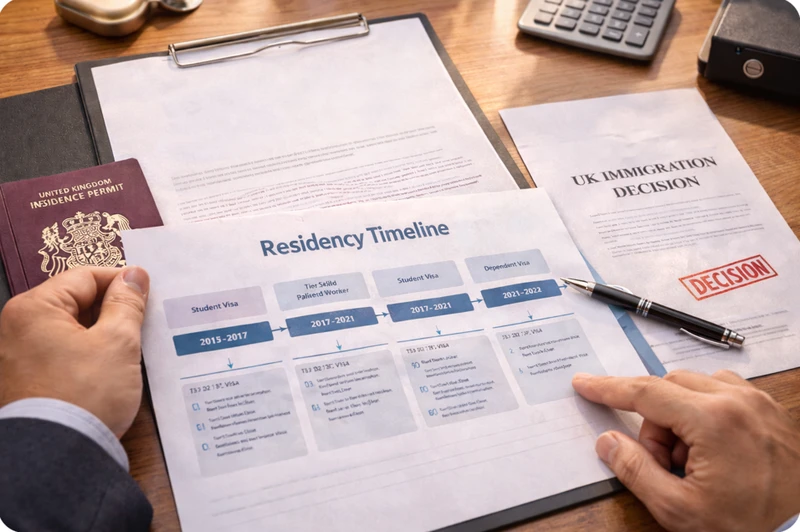
Understanding the 10-Year Long Residence Route
The long-residence route allows a person to apply for ILR after completing ten years of lawful residence in the UK. Lawful residence includes time spent under valid leave and certain periods of statutory protection, such as Section 3C, but it does not include all time physically spent in the UK.
Unlike some other settlement routes, long residence often involves multiple visa categories. Students, workers, dependants, family migrants and temporary routes may all feature in a single ten-year timeline. The Home Office accepts this diversity of leave, but it examines continuity and lawfulness closely.
Short Gaps vs Long Gaps: Why the Distinction Matters
One of the most common concerns is whether a gap between visas breaks continuous residence.
Short gaps
Short gaps often arise from:
- late applications submitted shortly after expiry,
- administrative errors,
- misunderstandings about application deadlines.
In limited circumstances, very short gaps may be disregarded, particularly where there is a clear explanation and strong evidence that the applicant intended to maintain lawful status. However, this is not automatic and depends on timing, context and credibility.
Longer gaps
Longer periods without leave are treated more strictly. Where an applicant has spent a meaningful period in the UK without lawful status, this will usually break long residence unless statutory protection applies or discretion is clearly justified.
The key point is that the Home Office now focuses less on rigid timelines and more on whether continuity of lawful residence can genuinely be maintained.
Overstays and Long Residence: A Narrow Margin for Discretion
Overstaying remains one of the most sensitive aspects of long-residence applications.
In 2025, caseworkers distinguish between:
- brief, explained overstays linked to administrative or legal uncertainty, and
- longer or repeated overstays indicating a pattern of unlawful residence.
While the Rules allow limited discretion, overstays are not automatically forgiven simply because an applicant has lived in the UK for ten years. Where discretion is exercised, it is usually because:
- the overstay was short,
- it occurred many years ago,
- it was followed by consistent lawful residence, and
- there is credible supporting evidence.
Applicants with multiple or prolonged overstays face a significantly higher refusal risk.
Section 3C Protection: Lawful Residence That Is Often Misunderstood
Section 3C of the Immigration Act 1971 is critical in many long-residence cases.
Where an in-time application or appeal is pending, Section 3C extends existing leave automatically, preventing a person from becoming an overstayer while the matter is decided. Time spent under Section 3C counts as lawful residence for the purposes of the ten-year route.
Problems arise when applicants assume they were protected when they were not. Common pitfalls include:
- submitting applications after leave had already expired,
- withdrawing applications without understanding the impact on Section 3C,
- gaps between refusals and fresh applications.
Correctly mapping Section 3C periods is often decisive in borderline cases.
Covid-19 and Exceptional Circumstances: A Narrowing Approach
During the pandemic, the Home Office adopted a more flexible stance towards absences and overstays caused by lockdowns, travel bans and service disruption. That approach has gradually tightened.
In 2025, Covid-related explanations are still considered, but they are no longer accepted at face value. Applicants must now show:
- a direct link between Covid disruption and the immigration issue,
- evidence that reasonable steps were taken to regularise status,
- consistency in lawful residence before and after the disruption.
Exceptional circumstances remain relevant, but they are interpreted more cautiously than in earlier years.
Varied Leave Types and “Patchy” Immigration Histories
A common misconception is that long residence requires stability in visa category. It does not.
Switching between different lawful routes — for example, from student to work, from work to family, or between temporary routes — does not in itself undermine a long-residence application. What matters is lawfulness and continuity, not uniformity.
That said, a history involving frequent switches, short grants of leave or multiple refusals will attract closer scrutiny. The Home Office now looks at the overall pattern: whether the applicant has consistently sought to comply with the Rules or has repeatedly relied on discretion to remain.
How the Home Office Now Treats Discretion
Discretion under Appendix Long Residence still exists, but it is no longer informal or generous. Caseworkers apply it within clearer boundaries, guided by internal policy and recent case law.
In practical terms, discretion is most likely to assist applicants where:
- issues are historic rather than recent,
- gaps or overstays are isolated rather than repeated,
- there is a strong evidential narrative explaining what happened,
- the overall ten-year period shows sustained lawful residence.
Applicants with multiple weaknesses should not assume discretion will “fix” a problematic record.

FAQ: Long Residence ILR in 2025
Can I get 10-year ILR if I had gaps in my visa history?
Possibly. Short, explained gaps may be disregarded, but longer or repeated gaps usually break continuous residence unless Section 3C protection applies or discretion can clearly be justified.
How long a gap breaks continuous residence for long-residence ILR?
There is no single fixed number. The Home Office assesses length, timing and context. The longer the gap, the harder it is to preserve continuity.
Does Section 3C count as lawful residence for 10-year ILR?
Yes. Time spent under valid Section 3C protection counts as lawful residence, provided it arose from an in-time application or appeal.
Can overstays be disregarded under the long-residence rules?
Only in limited circumstances. Short, historic overstays with strong explanations may be overlooked, but overstays remain a major refusal risk.
Will Covid-related gaps still be accepted in 2025 ILR applications?
They may be, but only with clear evidence. Covid discretion is now applied more narrowly than in earlier years.
What counts as exceptional circumstances for long-residence ILR?
Exceptional circumstances must be compelling, well-evidenced and directly linked to the immigration issue. They are assessed case by case.
Do different visa types count towards the 10-year long-residence route?
Yes. Time spent under different lawful visa categories can be combined, provided residence remains lawful and continuous.
Can I rely on Home Office discretion if my history is patchy?
Discretion exists but is limited. It cannot correct repeated or recent breaches of immigration law.
Why are long-residence ILR applications refused despite ten years in the UK?
Refusals usually arise from unlawful gaps, misunderstood Section 3C periods, overstays, or insufficient evidence of continuity.
Should I apply for long-residence ILR if my record is not “perfect”?
Possibly — but only after careful assessment. Timing, evidence and legal strategy are critical in non-standard cases.
Conclusion
The long-residence route remains a viable path to settlement, but it is no longer forgiving by default. In 2025, the Home Office accepts that few ten-year histories are flawless, yet it expects applicants to demonstrate sustained compliance with the immigration system.
Gaps, overstays and varied leave types are not automatically fatal, but they must be understood, explained and evidenced with care. Where discretion applies, it does so within clearer limits than before.
How Barar & Associates Can Help
We regularly advise on complex long-residence cases, including those involving gaps, overstays, Section 3C protection and mixed visa histories. Our work includes strategic assessments, evidence preparation and representation in high-risk applications.
If you are considering a 10-year long-residence ILR application and are unsure how your history will be viewed, tailored advice can make a decisive difference.
barar.london@bararassociates.co.uk
020 7487 8370