
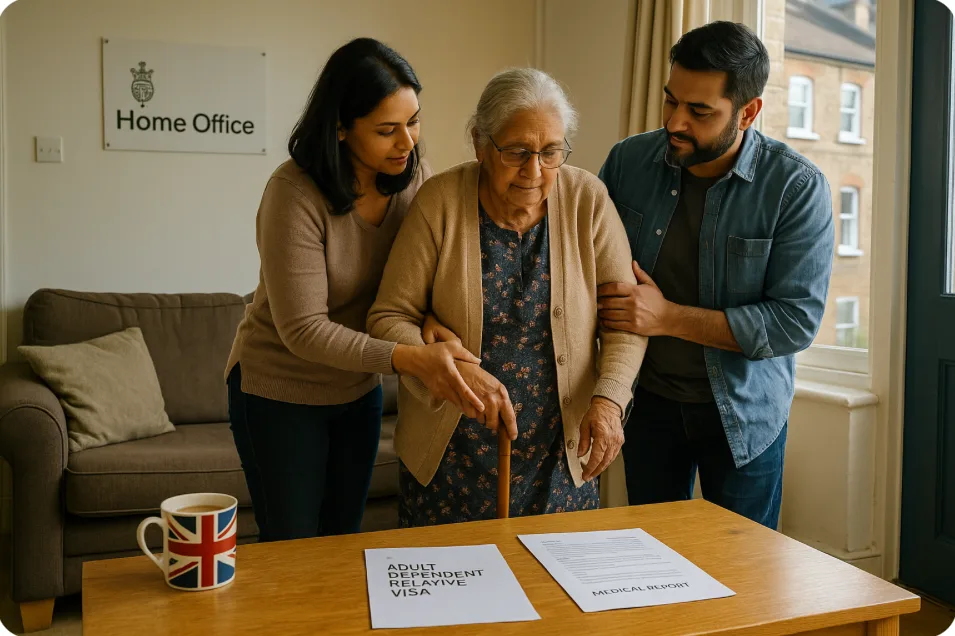
If you’re exploring the adult dependent relative route for an elderly dependent, this guide explains the adult dependent relative immigration rules, the BritCits judgment, evidence you’ll need, and what’s realistic when people ask about the elderly dependent visa UK success rate (sometimes called the elderly dependant visa UK).
Key points at a glance
- The ADR route is for parents, grandparents, adult children or siblings of a UK-based sponsor who require long-term personal care to perform everyday tasks because of age, illness or disability—and that care is not available or not affordable in the country where they live. Applications are normally made from outside the UK as entry clearance.
- In practice, this is one of the most demanding UK family routes: evidence thresholds are high and grants are comparatively rare. Independent practitioner summaries regularly report very low grant rates (often quoted around 4–5%), reflecting the strictness of the test rather than fixed quotas. Official success-rate datasets are limited.
The BritCits judgment—what it decided
In R (BritCits) v Secretary of State for the Home Department, the High Court (2016) and later the Court of Appeal (2017) upheld the lawfulness of the tightened ADR rules, though they left room for individual challenges on the facts. The courts confirmed that requiring proof that adequate care is unavailable or unaffordable abroad is lawful. For applicants, that means the evidential bar is high and case preparation is crucial.
Adult Dependent Relative immigration rules (what you must prove)
To meet Appendix Adult Dependent Relative you generally need to show:
- Relationship & age: the applicant is a qualifying relative (parent/grandparent, adult child, or sibling) of a sponsor who is British, settled or has protection status; and is 18+.
- Care needs: independent medical evidence proves long-term personal care is required to carry out everyday tasks due to age, illness or disability.
- Care not available/affordable: credible, country-specific evidence shows suitable care cannot be accessed or cannot be afforded in the country of residence.
- Maintenance & accommodation in the UK without recourse to public funds, meeting adequate maintenance and adequate accommodation tests.
- Application timing/location: normally entry clearance before travel; limited in-country routes are exceptional (e.g., human rights claims).
Looking for the elderly dependent visa UK success rate? There isn’t a frequently updated official percentage, but practitioner analyses and firm data indicate the route is exceptionally difficult, with low approval rates. Robust evidence and tailored legal submissions can materially improve prospects.
Evidence that moves the dial
- Medical evidence from relevant specialists describing diagnosis, prognosis, functional limitations, and why personal care is required long term (not just assistance).
- Country-specific care research: reports, quotes and letters demonstrating availability, quality, and costs of appropriate care options locally—and why these are unavailable or unaffordable to the family.
- Sponsor’s undertaking & means: finances and housing that satisfy adequate maintenance and adequate accommodation guidance.
FAQs
Is the ADR route only for parents?
No. It can cover parents, grandparents, adult children, or siblings of the UK sponsor, but aunts/uncles/cousins are excluded.
Can an elderly parent switch inside the UK?
Usually no—the rules anticipate entry clearance from abroad. Human rights-based applications can be possible but are complex and fact-sensitive.
Why is the success rate perceived as low?
Because applicants must prove both serious care needs and that suitable care cannot realistically be provided in the home country. This two-limb test, confirmed in BritCits, explains why grants are relatively rare.
How Barar can help on Adult Dependent Relative cases
At Barar & Associates we build ADR cases from the ground up: instructing suitable medical experts, compiling country-of-origin care evidence, addressing adequate maintenance/accommodation, and preparing representations that engage the adult dependent relative immigration rules and the reasoning in BritCits. If you’re researching the elderly dependant visa UK or searching “elderly dependent visa UK success rate”, speak to us early—front-loaded evidence is critical.
Book a consultation: barar.london@bararassociates.co.uk · 020 7487 8370